XAD – Structuring a Multi-Department Tender & Risk System
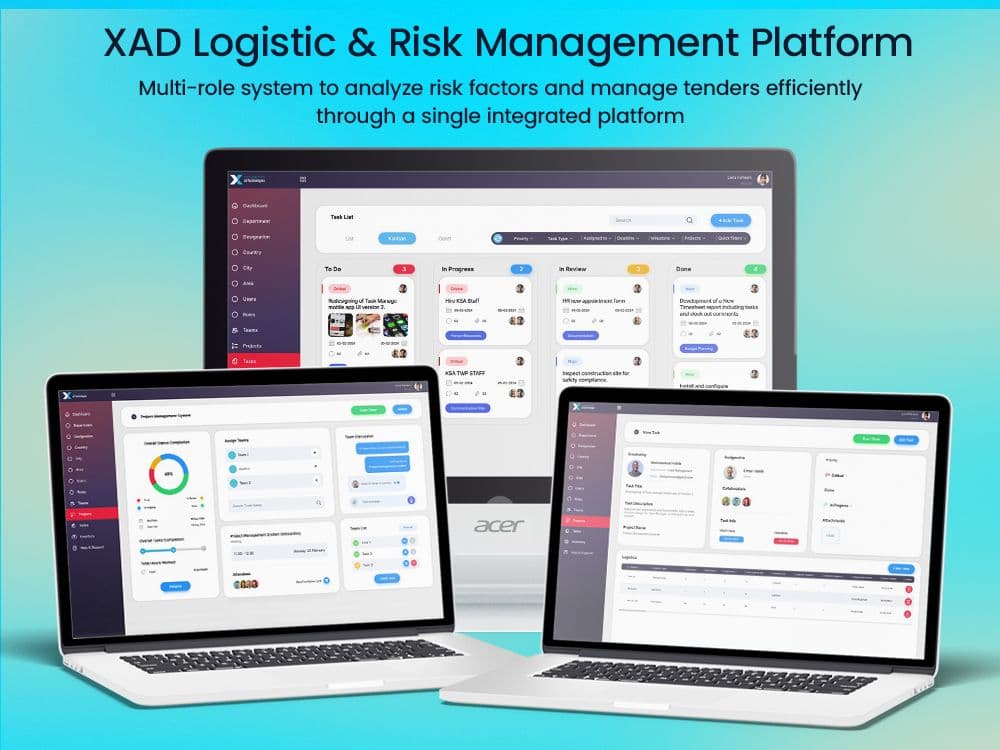
XAD was built to manage the full lifecycle of construction tenders—from identifying opportunities to evaluating risk, making bidding decisions, and tracking execution across departments.
Context
XAD was built to manage the full lifecycle of construction tenders—from identifying opportunities to evaluating risk, making bidding decisions, and tracking execution across departments.
Before this system, the process was highly fragmented. Different teams operated independently, often without a unified structure or shared visibility.
The Real Problem
The core issue wasn’t just inefficiency—it was lack of alignment:
- Departments worked in isolation
- No single source of truth for tender data
- Inconsistent risk evaluation and decision-making
- Difficulty tracking progress across teams
- Heavy reliance on manual coordination
From a business perspective, this made it difficult to confidently answer:
“Should we bid on this project or not?”
My Role
I worked as a Senior Front-End Engineer & Team Lead, with responsibilities extending beyond frontend development:
- Communicated with multiple departments to gather requirements
- Translated business workflows into structured system flows
- Created documentation, flowcharts, and process maps
- Led the frontend team and guided implementation
- Collaborated with UI/UX designers on system structure and experience
- Worked closely with backend teams to align APIs and data
- Engaged with end users to validate the system throughout development
My Approach
The first step was not coding—it was understanding the system:
- Studied how each department operates
- Identified how data flows between teams
- Mapped the complete tender lifecycle
- Broke complex workflows into manageable steps
Focus: Build clarity before building the system.
Shaping the System
Once workflows were clear, I structured the platform:
- Defined role-based interactions within the system
- Designed a multi-role architecture for different departments
- Enabled teams to manage their own responsibilities independently
- Ensured all teams remained connected through shared data
This created a balance between autonomy and collaboration.
Building the Product
Development progressed in a structured and coordinated way:
- Implemented frontend architecture for multi-role workflows
- Integrated APIs for structured data exchange
- Designed user flows for risk analysis, approvals, and tracking
- Maintained consistent UI/UX across modules
- Led the frontend team to ensure quality and consistency
The goal was to make a complex system feel intuitive and manageable.
Key Challenges & Solutions
1. Understanding Multiple Departments
Each department had unique processes and expectations.
👉 Addressed this by directly engaging with stakeholders and aligning workflows into a unified system.
2. Complex Workflow Mapping
The tender lifecycle involved multiple stages and decision points.
👉 Broke it into structured steps and visualized it through flowcharts before implementation.
3. System Usability
Complex systems can quickly become overwhelming.
👉 Focused on clear UI flows and role-based access to maintain simplicity.
4. Team Coordination
Frontend, backend, and design teams needed strong alignment.
👉 Acted as a bridge to ensure all teams worked toward a shared structure.
Outcome
- Unified the entire tender lifecycle into a single platform
- Improved coordination across departments
- Enabled more structured and confident decision-making
- Reduced reliance on manual communication and tracking
What This Project Taught Me
- Building systems is as much about communication as it is about code
- Clear structure solves more problems than complex logic
- Understanding business workflows leads to better technical decisions
- Leadership is about aligning people, not just managing tasks
Final Thought
This project stands out because it wasn’t just about building features.
It was about bringing multiple teams, processes, and decisions into one system—and making it work in a way that people can actually use.